
AI Anomaly Detection and IACS UR E26/E27: What Counts as Compliance Evidence
Why this question keeps coming up
Two IACS Unified Requirements, UR E26 "Cyber resilience of ships" and UR E27 "Cyber resilience of on-board systems and equipment," took effect on 1 July 2024, applying to ships contracted for construction on or after that date. UR E26 sets requirements at the whole-ship level; UR E27 sets the minimum security capabilities that individual on-board computer-based systems and equipment must meet, aimed mainly at suppliers. Together they are the first IACS-wide, mandatory baseline for cyber resilience that new ships and their equipment have to meet before a classification society will approve them.
Inside UR E26, one specific functional element, section 4.3, "Detect," is where AI and machine-learning marketing has landed hardest in the last two years. Vendors selling AI-based network monitoring and anomaly detection tools often point to this section as the reason to buy their product. It is worth reading exactly what the rule says before deciding whether that pitch is accurate.
What UR E26 section 4.3 actually requires
The rule's own rationale explains the thinking: "Cyber-attacks are becoming increasingly sophisticated, and attacks that target vulnerabilities that were unknown at the time of construction could result in incidents where the vessel is ill-prepared for the threat. To enable an early response to attacks targeting these types of unknown vulnerabilities, technology capable of detecting unusual events is required. A monitoring system that can detect anomalies in networks and that can use post-incident analysis provides the ability to appropriately respond and further recover from a cyber event."
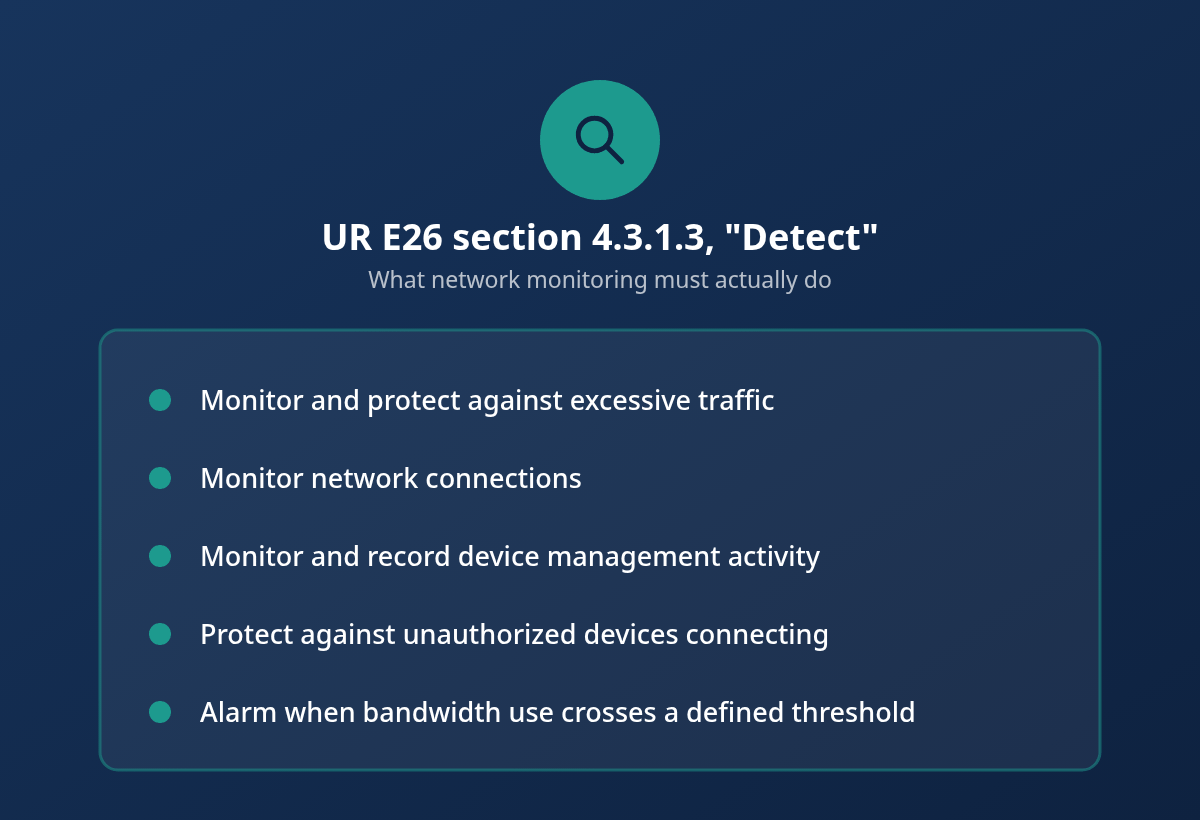
The binding requirement itself, section 4.3.1.1, is short: "Networks in scope of this UR shall be continuously monitored, and alarms shall be generated if malfunctions or reduced/degraded capacity occurs." The requirement details in 4.3.1.3 list specific capabilities the monitoring measures must have:
- Monitoring and protection against excessive traffic
- Monitoring of network connections
- Monitoring and recording of device management activities
- Protection against connection of unauthorized devices
- An alarm generated if network bandwidth utilization exceeds a threshold the supplier has specified as abnormal
Notice what is absent from this list: there is no mention of artificial intelligence, machine learning, or any particular detection method. The rule specifies an outcome, continuous monitoring with alarms on abnormal conditions, not a technology for achieving it. A simple rules-based threshold monitor that reliably does this satisfies the requirement exactly as well, on paper, as a machine-learning anomaly detector that does the same job.
Where intrusion detection systems fit, and their limits
UR E26 does allow intrusion detection systems (IDS), the category many AI-marketed products fall into, but with conditions attached in section 4.3.1.3: "The IDS shall be qualified by the supplier of the respective CBS. The IDS shall be passive and not activate protection functions that may affect the performance of the CBS. Relevant personnel should be trained and qualified for using the IDS." The passive requirement is the detail most worth noting. An IDS under this rule is allowed to watch and alert, not to automatically block traffic or shut systems down, because an automated response that misfires on a ship's operational technology network can itself cause an unsafe condition. An AI system confident enough to act autonomously on what it thinks is an attack is, under this specific rule, doing something the rule does not ask for and arguably should not be doing without a human in the loop.
What a surveyor actually checks, and when
This is the part a sales conversation about "AI-powered compliance" tends to skip. UR E26 section 4.3.1.4 breaks demonstration of compliance into phases, and most of the real evidence requirements fall in commissioning and operation, not simply in having bought a product:
| Phase | What has to be demonstrated |
|---|---|
| Commissioning | Test that disconnected network connections trigger an alarm and the event is recorded; test that abnormally high network traffic is detected with alarm and audit record generated; demonstrate the system responds safely to network storm scenarios; demonstrate generation of audit records; if an IDS is implemented, demonstrate it is passive and will not affect the CBS's intended operation |
| First annual survey (operation phase) | Present records or other documented evidence that CBSs are "routinely monitored for anomalies by inspection of security audit records and investigation of alerts" |
| Ongoing operation | The shipowner's Ship cyber security and resilience program must describe the management activities used to detect anomalies, covering how anomalous activity is revealed and recognized, how security audit records are inspected, and the instructions or procedures used to detect incidents |
In other words, the evidence a Society actually asks for is documentation and demonstrated process: audit records exist, alerts get investigated, personnel are trained, and the behavior was tested at commissioning. Buying an AI-branded monitoring tool does not by itself satisfy any line in that table. What satisfies it is showing the tool generates the required audit records, that someone qualified reviews what it flags, and that this review is a described, repeatable part of the ship's cyber security and resilience program.
A practical way to evaluate a vendor's claim
- Ask which specific requirement in UR E26 section 4.3.1.3 the product addresses, by number, not by marketing language
- If it is pitched as an IDS, confirm it is qualified by the supplier of the computer-based system it sits on, as the rule requires, not a generic bolt-on
- Confirm it operates passively and does not automatically take protective action that could affect the performance of the system it is monitoring
- Check that its output format actually produces the audit records and alert logs a surveyor will ask to inspect at the first annual survey
- Ask who on board or ashore is trained and assigned to review what the tool flags, since the rule assumes a qualified person does that review, not the tool itself
Why this distinction matters beyond the paperwork
UR E27 reinforces the same logic from the equipment side: a system or piece of equipment is "cyber resilient" if it is built and documented to the required security capabilities, which is a property of its design and its supplier's secure development lifecycle, not a label a shipowner can add afterward by installing a monitoring dashboard. An AI anomaly detector bought after delivery can genuinely help a crew or shore team notice something unusual faster than a person scanning logs manually, and that operational value is real. But it sits on top of the UR E26/E27 compliance picture, as one possible tool for meeting the "Detect" requirement, rather than being the requirement itself. Confusing the two is how a company ends up with an expensive monitoring product and still fails an annual survey because nobody can show the audit trail and review process the rule actually asks for.
FAQ
Do IACS UR E26 and E27 require AI-based cybersecurity tools?
No. Neither requirement mentions artificial intelligence or machine learning. UR E26 section 4.3 requires continuous network monitoring capable of detecting anomalies and generating alarms, which can be met with rules-based monitoring, an AI-based tool, or a combination, as long as the specific capabilities and evidence the rule lists are demonstrated.
Can an AI intrusion detection system automatically block suspicious traffic on a ship's network under UR E26?
Under section 4.3.1.3, an IDS implemented to meet this requirement must be passive and must not activate protection functions that could affect the performance of the computer-based system it monitors. An automated blocking response goes beyond what this specific provision permits.
What evidence does a surveyor actually check for the "Detect" requirement?
Mainly documented evidence and demonstrated process: commissioning tests showing alarms and audit records are generated correctly, and at the first annual survey, records or other documented evidence that computer-based systems are routinely monitored for anomalies through inspection of security audit records and investigation of alerts.
Talk to us
Maritime.Studio builds maritime cyber awareness and compliance training for crews, superintendents and DPAs, including how to read class society cyber resilience requirements accurately rather than by vendor marketing. See our cybersecurity glossary, our maritime cyber awareness training, or get in touch.