
Running an AI-Assisted PSC or Vetting Document Review in the Shore Office
What a PSC or vetting file actually contains
Port State Control, as IMO describes it, is the inspection of foreign ships in national ports to check that the vessel, its equipment, and its crew meet international standards, acting as a safety net behind the flag State's own responsibility for compliance. Nine regional agreements, including the Paris MoU and the Tokyo MoU, coordinate these inspections so the same ship is not checked repeatedly for the same things.
A vetting review, such as one run under OCIMF's SIRE 2.0 programme, works differently but touches similar documents. SIRE originally launched in 1993 to address concerns about sub-standard tanker shipping, and the 2.0 version digitalised the process. An inspection under SIRE 2.0 covers the vessel's structure, machinery, and equipment, and includes interviews with officers and crew to confirm they can carry out their duties under the company's own procedures, with the operator required to submit a pre-inspection declaration at least 48 hours ahead.
Either way, the shore office is usually assembling the same core set: current certificates, the vessel's deficiency history, outstanding corrective actions, recent internal audit findings, and planned maintenance system status for the systems most likely to draw attention.
Where AI genuinely helps
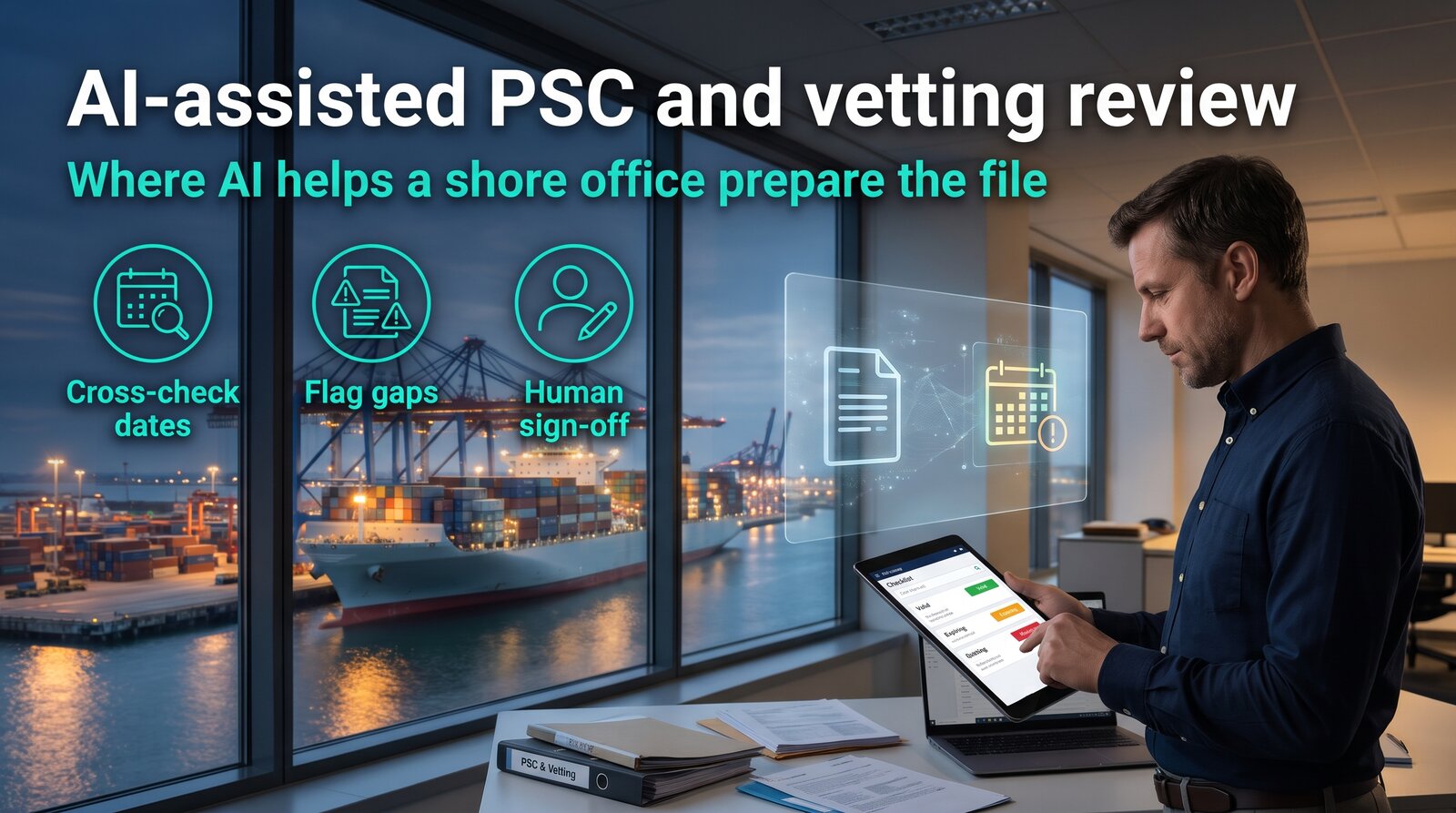
- Cross-checking dates. Feeding a list of certificate names and expiry dates to an AI tool to flag anything expiring within the inspection window is a clean, low-risk task, as long as a person then checks each flag against the actual certificate.
- Summarising long documents. A recent class society circular or a regulatory update can run to many pages. An AI summary is a fast way to decide whether it is relevant before a superintendent reads the original in full.
- Finding inconsistencies across documents. If a corrective action closed out in one report still appears open in another, an AI tool can catch that mismatch for a human to resolve, faster than a manual line-by-line comparison.
- Drafting corrective action text. A first draft of a written response to a past deficiency, built from the superintendent's notes, is a reasonable starting point as long as the final wording and the facts in it are checked against what actually happened on board.
Where it must not replace the person
An AI tool has no way to confirm that a certificate is genuinely valid, that a corrective action was actually carried out on board, or that a crew member can demonstrate the competence a document claims. OCIMF is explicit that the SIRE 2.0 process itself is an inspection, not an audit, carried out by a person who boards the vessel, interviews the crew, and verifies what they see. The office-side review before or after that inspection deserves the same standard: an AI tool can prepare the ground, but a qualified person makes the judgement call on readiness, and signs their name to it.
A five-step workflow
| Step | Who does it | What happens |
|---|---|---|
| 1. Gather the file | Superintendent or DPA assistant | Pull certificates, past deficiencies, corrective actions, and PMS status into one folder |
| 2. AI first pass | AI tool, supervised | Check expiry dates against the inspection window, flag missing documents, summarise long circulars |
| 3. Human review of every flag | Superintendent | Check each flag against the source document, not the AI summary of it |
| 4. Fix or explain each gap | Superintendent with vessel | Close genuine gaps before the inspection, or prepare an honest explanation where closing it in time is not possible |
| 5. Sign-off and log | DPA | Confirm the file is complete, record what the AI tool was used for, and keep that record with the inspection file |
Step five matters as much as step one. If an inspector, auditor, or class surveyor later asks how the file was prepared, the office should be able to show exactly where an AI tool was used, what it was asked to do, and who checked its output, in the same way the company already documents who approved an SMS procedure under the ISM Code.
In practice, a flag such as "Certificate X expires in 11 days, inside the inspection window" is only a suggestion until the superintendent opens the actual certificate, confirms the date, and initials the check. The flag becomes a fact once a person confirms it against the original.
Keeping the file itself off public tools
The same data handling care that applies to voyage and maintenance reports applies here, arguably more so, since a PSC or vetting file concentrates a vessel's entire compliance history in one place. Treat any general-purpose AI tool as public unless your company's policy says otherwise, and never upload full certificates, crew lists, or the complete deficiency history as files. Work with extracted, anonymised snippets, such as a bare list of document names and dates, and keep the actual certificates and reports inside the company's own systems.
Maritime.Studio's glossary of regulations and class terms and vessel operations glossary cover the terminology this workflow assumes, and the training services page outlines how a session like this can be run for a DPA or superintendent team as a practical exercise rather than a slide deck.
A practice exercise for the office
Before the next real inspection, run a dry file review using last quarter's SIRE report or the most recent PSC inspection record as the test case. Have one superintendent run the AI first pass while a colleague works through the same file manually, then compare what each method caught and missed. This builds trust in the workflow before it carries real weight, and it usually surfaces at least one gap in how the file is currently organised, independent of AI.
FAQ
Can an AI tool decide whether a vessel is ready for a PSC inspection?
No. It can help organise and cross-check the file, but readiness is a judgement call made by a qualified person who knows the vessel's actual condition, not an output generated from a document summary.
Does using AI in file prep need to be disclosed to an inspector?
Inspectors are checking the vessel and its documents, not the office's internal workflow, so there is no general disclosure requirement for using an AI drafting tool. Keeping an internal record of how it was used is still good practice if questions come up later during an audit.
What is the difference between a PSC inspection and a SIRE vetting inspection for document prep purposes?
PSC is a government inspection checking compliance with international conventions, run under regional MoUs such as Paris MoU or Tokyo MoU. SIRE is an industry programme, run by OCIMF, that produces a report used by charterers, terminals, and other third parties to inform their own vetting decisions. The document sets overlap heavily, so a well-organised file supports both.
Talk to us
Maritime.Studio builds digital training for shore offices and crews, including how to bring AI tools into a document control process without weakening it. See our maritime cyber awareness training or get in touch.