
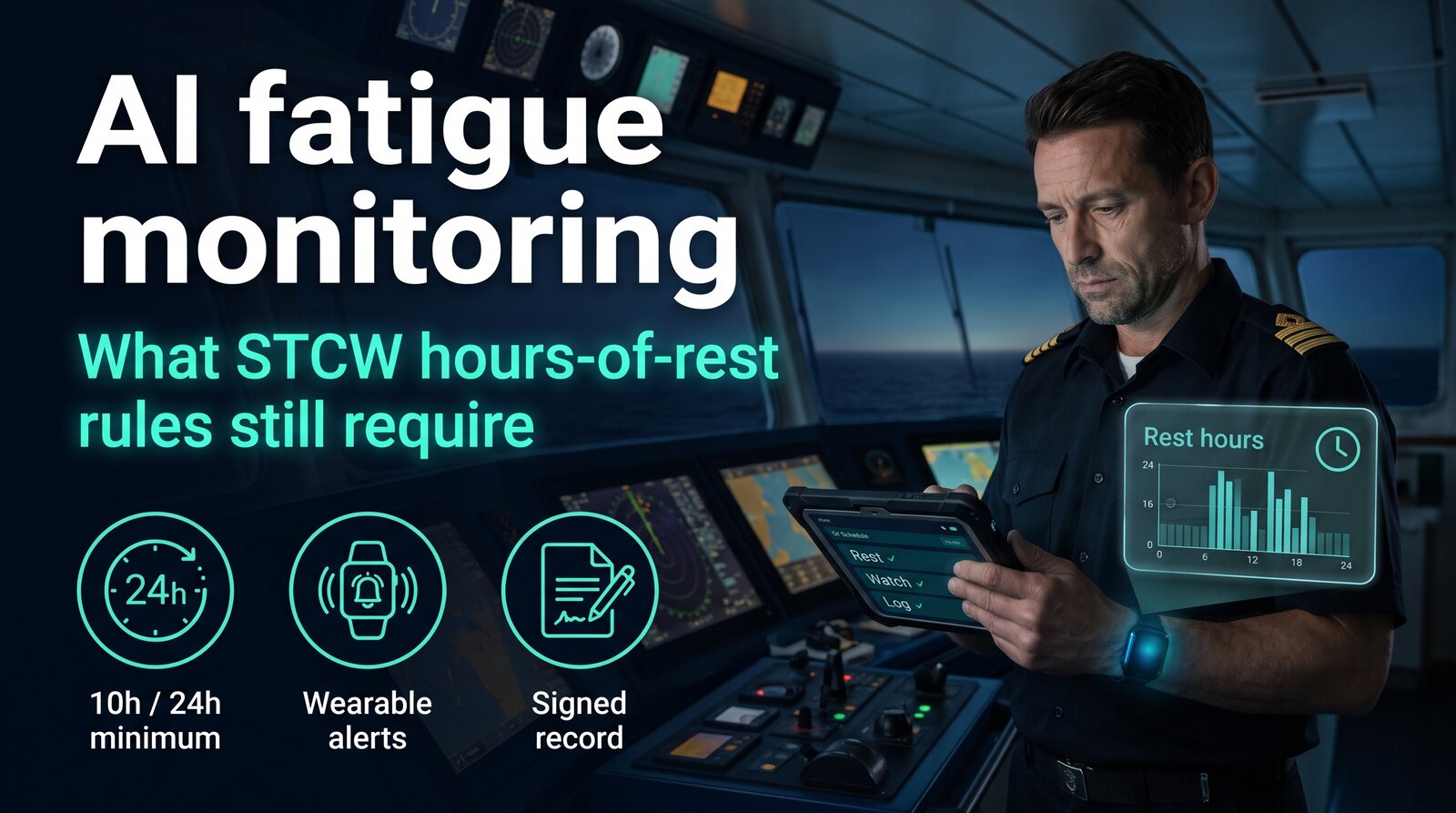
AI Fatigue-Monitoring Tools on Board: What STCW Still Requires
Wearables are showing up on the bridge
A growing number of shipping companies are piloting wearable devices and AI-based scheduling software that claim to flag a tired watchkeeper before a mistake happens: wristbands that estimate sleep quality, apps that model cumulative fatigue risk from a crew member's logged work and rest pattern, and rostering tools that warn a chief officer before a watch schedule quietly breaches the rest rules. The pitch is appealing: catch fatigue before it causes an incident, rather than after. Before adopting one of these tools, it helps to be precise about what the underlying rule already requires, because an AI fatigue tool sits on top of that rule. It does not replace it.
What STCW regulation VIII/1 actually says
The International Convention on Standards of Training, Certification and Watchkeeping for Seafarers (STCW) addresses fatigue directly in Regulation VIII/1, "Fitness for duty": "Each Administration shall, for the purpose of preventing fatigue: .1 establish and enforce rest periods for watchkeeping personnel; and .2 require that watch systems are so arranged that the efficiency of all watchkeeping personnel is not impaired by fatigue and that duties are so organized that the first watch at the commencement of a voyage and subsequent relieving watches are sufficiently rested and otherwise fit for duty."
The actual numbers are in the mandatory Section A-VIII/1 of the STCW Code:
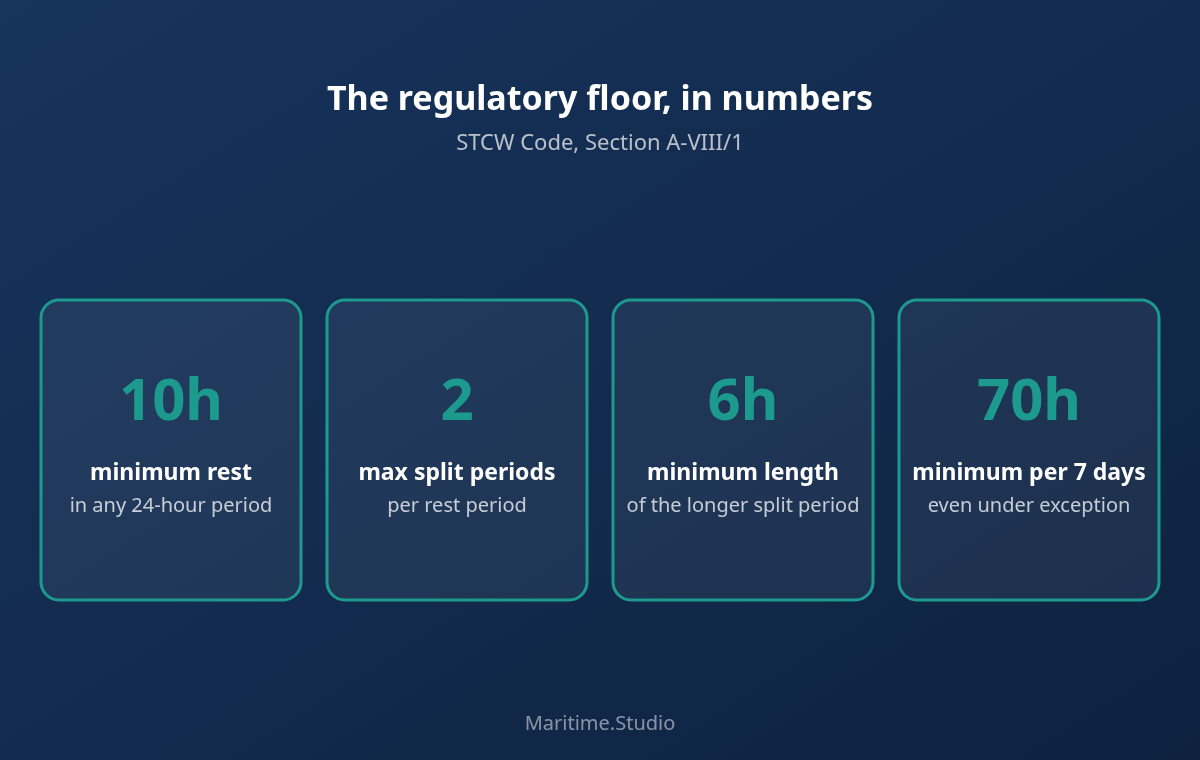
- A minimum of 10 hours of rest in any 24-hour period for anyone assigned duty as officer in charge of a watch, or as a rating forming part of a watch
- Rest may be divided into no more than two periods, one of which must be at least 6 hours long
- These minimums do not have to be maintained during an emergency, a drill, or other overriding operational conditions
- In a limited exception, the 10-hour minimum can be reduced to not less than 6 consecutive hours, provided the reduction does not continue beyond 2 days and at least 70 hours of rest are still provided in each 7-day period
- Administrations must require that watch schedules are posted where they are easily accessible
The parallel international instrument, the ILO's Seafarers' Hours of Work and the Manning of Ships Convention, 1996 (No. 180), sets a closely related but not identical floor: minimum rest of 10 hours in any 24-hour period and 77 hours in any 7-day period, divided into no more than two periods, one at least 6 hours long, with no more than 14 hours between consecutive rest periods. A joint IMO/ILO resolution on the matter specifically confirms that nothing in Convention No. 180 is meant to let a ratifying state that is also an STCW Party apply rest rules to watchkeepers that are less favourable than the STCW minimums. In practice, a company usually has to satisfy both sets of numbers at once, and the stricter one effectively governs.
| Rule | Minimum rest per 24 hours | Minimum rest per 7 days | Split allowed |
|---|---|---|---|
| STCW Section A-VIII/1 | 10 hours (can drop to 6 for up to 2 days under exception) | Not stated directly; exception requires at least 70 hours | Max 2 periods, one at least 6 hours |
| ILO Convention No. 180, Article 5 | 10 hours | 77 hours | Max 2 periods, one at least 6 hours, gap between periods no more than 14 hours |
Where an AI fatigue tool genuinely adds something
None of this regulatory text tells a chief officer how tired a specific watchkeeper actually is right now. The rules set a floor on hours; they do not measure sleep quality, circadian disruption from rotating watches, or the accumulated effect of several short nights in a row, all factors the IMO's own guidance on fatigue (the annex to resolution A.772(18), referenced directly in the STCW Code's guidance under Section B-VIII/1) explicitly recognizes as relevant to fatigue beyond raw hours worked. This is the genuine gap an AI-based tool can address: a wearable or app-based model that estimates sleep debt or predicts an elevated fatigue risk window is working on a question the hours-of-rest rule does not answer by itself, since two watchkeepers can both technically comply with the 10-hour minimum and still be in very different states of alertness.
A rostering tool that cross-checks a planned watch schedule against the actual STCW and MLC numbers before it is posted is a more modest, equally useful application: catching a scheduling error before it becomes a rest-hour violation is a compliance aid, not a judgment call about anyone's physical state.
Where it cannot replace the rule, or the record
Three limits are worth being explicit about with any crew or management team evaluating one of these tools:
- The documented record still has to exist. STCW and ILO Convention No. 180 both require records of seafarers' actual hours of work or rest to be kept, endorsed by the master or an authorized person and by the seafarer, so compliance can be checked. An AI tool's internal risk score is not a substitute for that record, and flag state or port state control inspectors will still look for the posted schedule and the actual hours logged, not a vendor's dashboard.
- A low fatigue-risk score does not excuse a rest-hour violation, and a compliant schedule does not guarantee low fatigue. These are two different measurements. A watch schedule can meet every STCW number and still leave someone genuinely fatigued because of poor sleep quality, illness, or stress unrelated to hours worked. The reverse is also possible: a tool might flag a watchkeeper as low-risk while the underlying schedule is already in breach of the posted rest-period minimums. Treat the two checks as complementary, not interchangeable.
- Responsibility for enforcing rest periods stays with the Administration and the company, under Regulation VIII/1, not with whichever software is installed. If a wearable or app-based tool is marketed as managing STCW fatigue compliance on its own, that claim goes further than what the regulation actually assigns to a technology vendor.
A practical way to bring one of these tools on board
- Keep the existing hours-of-work/hours-of-rest table and record-keeping exactly as STCW and Convention No. 180 require; treat the AI tool as an addition, not a replacement
- Ask the vendor what the tool actually measures: logged hours against the regulatory minimums, a separate biometric or self-reported fatigue estimate, or both, and keep those two outputs clearly distinct in how the crew reads them
- Decide in advance who reviews an alert from the tool and what they are expected to do about it, the same way an officer already responds to a scheduling conflict today
- Check that using the tool does not create a new administrative burden that itself eats into rest time, since the whole point of Regulation VIII/1 is protecting that time
- Remember the narrow STCW exception for reducing rest to 6 hours still caps out at 2 days and still requires 70 hours across the 7-day period; a tool cannot create a wider exception than the rule allows
FAQ
What is the minimum rest period required under STCW?
Section A-VIII/1 of the STCW Code requires a minimum of 10 hours of rest in any 24-hour period for watchkeeping personnel, divided into no more than two periods with one at least 6 hours long. A narrow exception allows the 10-hour minimum to drop to 6 consecutive hours for up to 2 days, provided at least 70 hours of rest are still given in that 7-day period.
Can an AI fatigue-monitoring tool replace the STCW hours-of-rest requirement?
No. The regulatory minimums and the record-keeping requirement under STCW and ILO Convention No. 180 still apply regardless of what any monitoring tool reports. A fatigue-risk score from a wearable or app is a separate measurement of alertness, not a substitute for the posted watch schedule or the logged hours record an inspector will check.
Does ILO Convention No. 180 set the same numbers as STCW?
Close, but not identical. Both set a 10-hour minimum per 24 hours and allow splitting rest into two periods with one at least 6 hours. Convention No. 180 additionally sets a 77-hour floor per 7 days and a maximum 14-hour gap between rest periods. Where a state is party to both instruments, the more protective requirement for watchkeepers governs.
Talk to us
Maritime.Studio builds training for crews and shore teams on how new technology, from AI tools to digital rostering, fits around existing STCW and safety management requirements rather than replacing them. See our training and certification glossary or get in touch.