
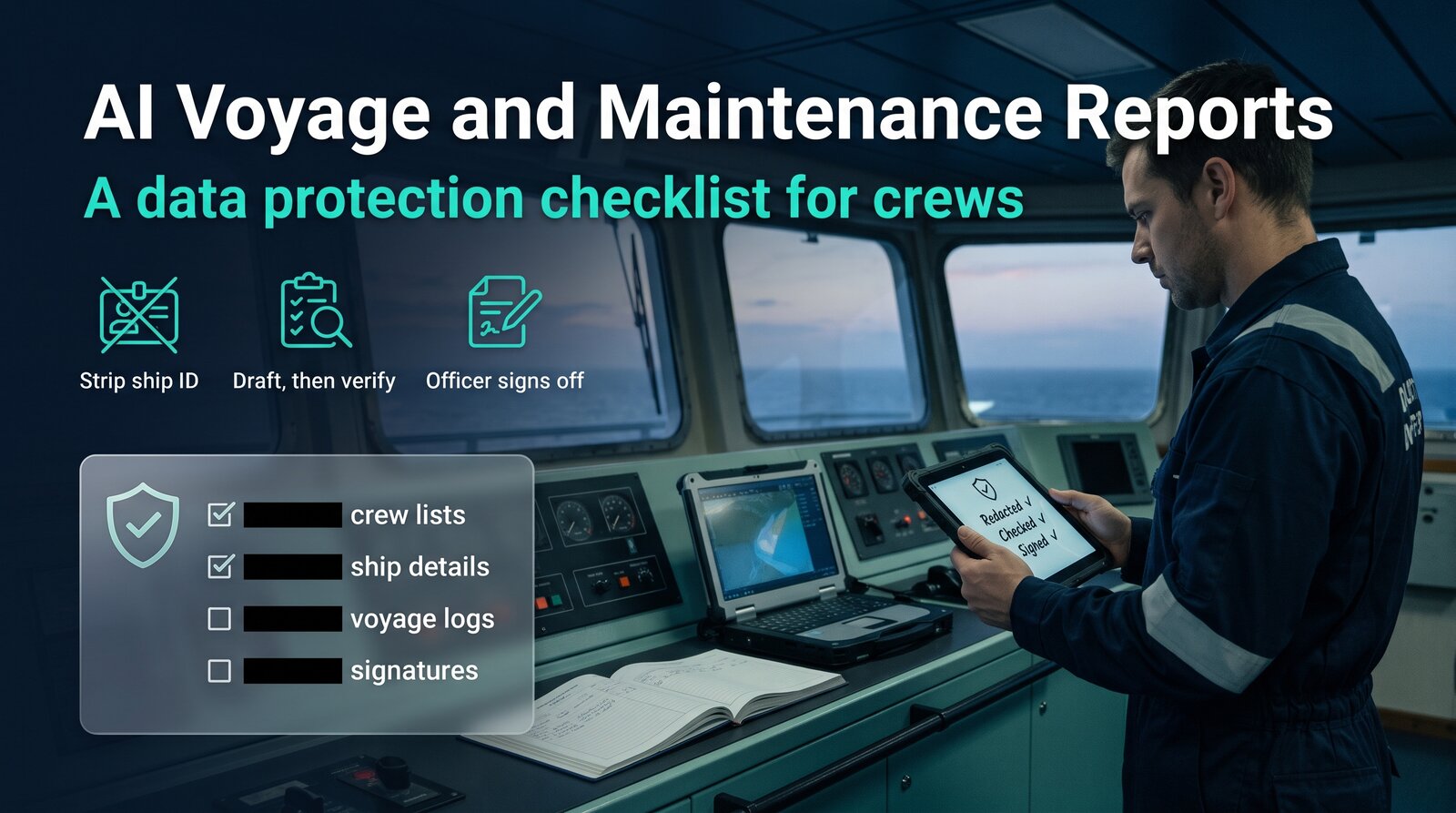
Drafting Voyage and Maintenance Reports with AI: A Data Protection Checklist for Crews
What counts as sensitive on a report
Before drafting anything, it helps to know what you are actually protecting. A typical voyage or maintenance report can carry several categories of sensitive data at once:
- Position, route, ETA, and speed, which together describe where a specific vessel will be and when
- Cargo type, quantity, and consignee, which can reveal commercial terms a charterer has not made public
- Crew names, ranks, nationalities, and sometimes passport or seaman's book numbers
- Equipment make, model, and fault history, useful to a competitor or to anyone profiling the vessel's security posture
- Internal reference numbers that tie a report to a specific contract, claim, or insurance case
None of this is secret in the sense of being classified, but it is exactly the kind of operational and commercial detail a company would not publish, and pasting it into a public AI tool can do something close to that if the tool's terms allow the input to be stored or used for training.
The checklist
Keep this short enough to use every time, including on a tired middle watch when a checklist is the last thing anyone wants to open.
- Pick the task, not the tool first. Ask whether an AI assistant is actually suited to this: tightening grammar and structure, yes; deciding what happened during an incident or what caused a fault, no. The officer who was there writes the facts.
- Strip identifying detail before you paste. Replace the vessel name, exact position, cargo party, and crew names with placeholders such as "Vessel A," "Port X," or "Officer 1" while drafting. Put the real detail back in after you have the structure you want, working in your own document, not in the chat window.
- Check what your company's AI policy allows. If your company has not published one yet, treat any general-purpose chatbot as public by default, and ask your DPA or superintendent before using it for anything beyond personal, non-vessel writing practice.
- Draft, then compare against the real event or reading. Treat the AI output as a first pass. Read it against your own notes, the logbook, or the sensor reading, and correct anything that does not match. A fluent sentence is not the same as an accurate one.
- The reporting officer signs off, not the tool. Whoever is accountable for the report, master, chief engineer, or officer of the watch, reads the final version in full and takes ownership of it before it goes to the office. The AI tool is a drafting aid, not a source.
Why this is a real risk, not a formality
Maritime cyber risk management guidelines from IMO, MSC-FAL.1/Circ.3, describe cyber risk management as something that should sit inside a company's existing risk management process rather than as a separate, occasional exercise. Resolution MSC.428(98), adopted by the Maritime Safety Committee in June 2017, encourages administrations to make sure cyber risks are addressed in a company's safety management system no later than the first annual Document of Compliance verification after 1 January 2021. Feeding vessel-specific data into a third-party AI tool without a policy covering that use is exactly the kind of gap that guidance is meant to close, even though the report itself looks like routine paperwork rather than a safety-critical document.
The NIST AI Risk Management Framework, published in January 2023, frames this the same way from a different angle: governing how an AI tool is used sits alongside judging how well it performs, as part of managing the risk it introduces. A company does not need to adopt the full framework to borrow its basic logic: decide who owns the AI use policy, decide what data categories are off-limits for general-purpose tools, and write that down before crews improvise their own rules report by report.
A worked example
A second engineer is writing up a recurring fault on a purifier. The rough notes read: "purifier tripped again, third time this month, bearing noise before trip, replaced bearing set, logged in PMS." Instead of pasting that with the vessel name and job card number attached, the engineer drafts with placeholders: "Purifier [unit ref] tripped for the third time this month. Bearing noise was audible before the trip. Bearing set replaced and logged in the planned maintenance system." The AI assistant tightens the wording and suggests a clearer structure. The engineer then puts the real unit reference and job card number back into the finished entry, checks it against the actual PMS record, and signs it off. The company's system never saw a public AI tool, only the structure of the sentence did.
Building this into onboard practice
A short toolbox talk is enough to introduce this. Walk through the five-step checklist with a real but anonymised example, let officers try redacting a sample report themselves, then compare drafts as a group. Pair it with your company's written AI use policy if one exists, or flag to the office that one is needed if it does not. The cybersecurity glossary and vessel operations glossary on this site cover related terms if your crew needs a shared vocabulary before the session, and Maritime.Studio's training services can build this into a fuller onboard or office course if you want it delivered as a structured module.
FAQ
Is it ever acceptable to use a public AI chatbot for ship reports at all?
It can be, for the drafting stage of non-sensitive text, if your company's policy allows it and identifying details are stripped out first. The decision belongs to the company, not to individual officers improvising on a busy watch.
Who should write the company's AI use policy for reporting?
Typically the DPA or a superintendent with input from IT or cyber security leads, following the same logic the company already applies to its Safety Management System under the ISM Code. It does not need to be long, but it needs to name which tools are allowed and which data categories are off-limits.
What should an officer do if they already pasted sensitive data into a public AI tool by mistake?
Report it to the DPA or superintendent the same way you would report any other procedural slip, rather than quietly moving on. Most AI providers publish a process for requesting data deletion, and the company can decide whether to use it and whether the incident needs wider follow-up.
Talk to us
Maritime.Studio builds digital training for shore offices and crews, including how to bring AI tools into daily reporting without creating a data protection gap. See our maritime cyber awareness training or get in touch.