
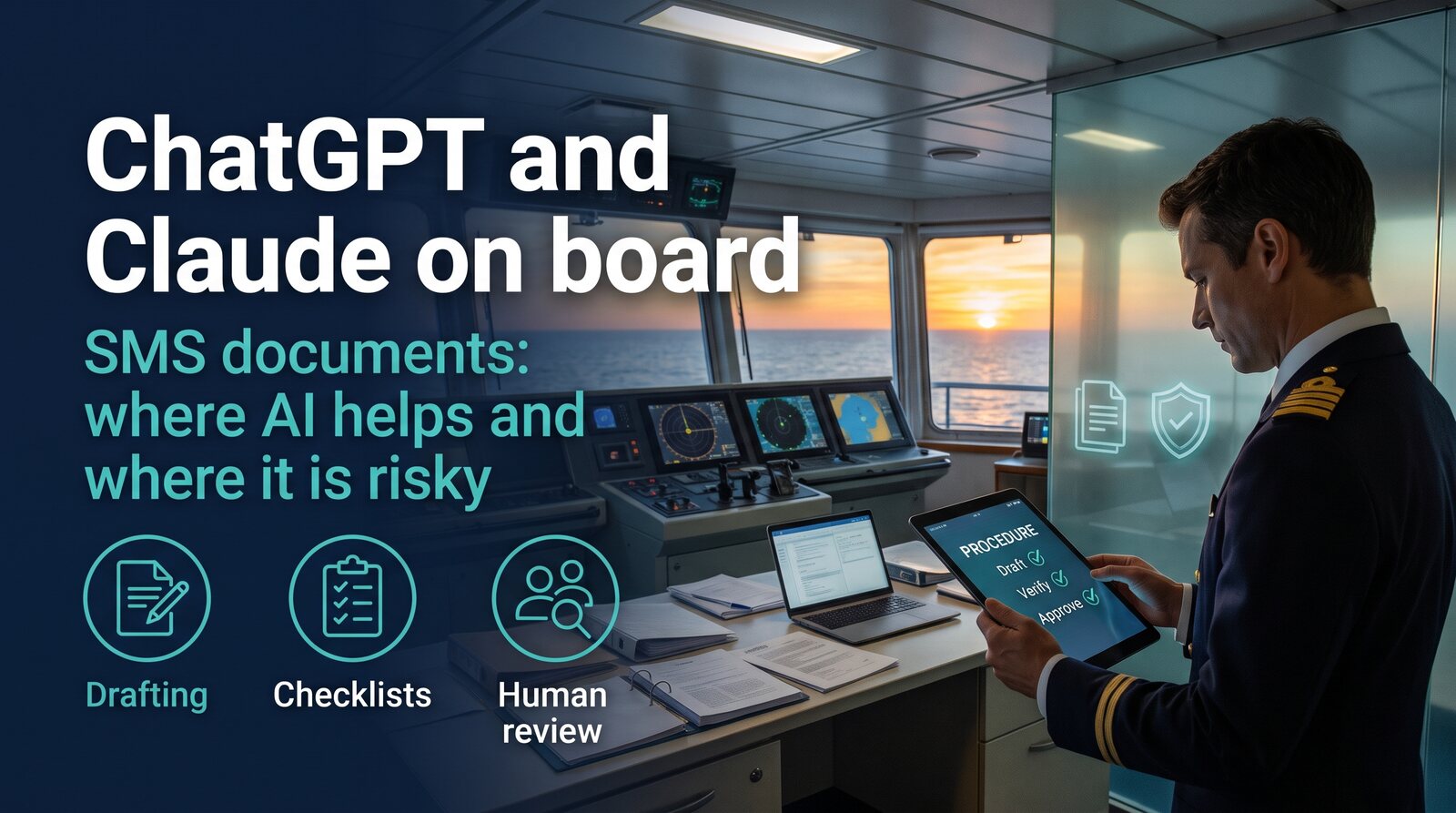
Using ChatGPT or Claude for SMS Documents on Board: Where It Helps and Where It Is Risky
What people mean by this
Over the past two years, deck officers, superintendents and DPAs have started experimenting with general-purpose chatbots such as ChatGPT and Claude to help write or revise safety management system (SMS) material: circulars, checklists, onboard procedures, risk assessments, even training handouts. None of these tools are built specifically for maritime safety documentation. They are general language models trained on broad text, which is exactly why they can be useful for some tasks and risky for others.
Where it genuinely helps
- Drafting a first version of a routine document, such as a toolbox talk, a notice to crew, or a training handout, that a qualified person then checks and edits
- Proofreading and clarity: tightening language, fixing grammar, making an existing procedure easier to read for crew who are not native English speakers
- Summarising a long regulation or circular into plain language as a starting point, to be verified against the original text afterwards, not relied on directly
- Translating or adapting tone for a multinational crew, again as a draft that a competent reviewer checks
Where classification societies draw the line
Lloyd's Register's own review of generative AI tools concluded that something like ChatGPT "can be used to proofread emails effectively," but that it "should never be used for safety-critical tasks like passage planning." That distinction, useful for correspondence and administrative writing, unsafe for anything that directly drives an operational safety decision, is the right way to think about SMS documents too. A circular reminding crew to double-check mooring lines is administrative. A checklist that crew will actually follow during an enclosed space entry or a lifeboat drill is safety-critical, even though both look like "just text."
Why DNV frames this as a probabilistic-output problem
DNV's own material on AI governance frames the core issue plainly: adding AI into any system adds new risk, because generative AI is probabilistic by nature, it produces a statistically likely answer, not a verified one. DNV Maritime has separately studied using large language models to help draft replies to shipowners and managers, and found real value there, but that is a correspondence task with a human reviewer in the loop before anything is sent, not a procedure that crew will later follow under pressure. A probabilistic tool is fine as a drafting assistant inside a document control process that already requires review and approval, and risky the moment its output skips that review and reaches the vessel as if it were approved.
The specific risk with SMS documents
An SMS procedure exists inside a formal document control system for a reason: someone competent wrote it, someone with authority approved it, and it is version-controlled so everyone on board works from the same current copy. A chatbot has no knowledge of your vessel's actual equipment, your company's approved procedures, or the latest amendment to a regulation unless you give it that information in the prompt, and even then it can produce a plausible-sounding but incorrect answer, a known general limitation of large language models usually called "hallucination." If a draft generated this way reaches the vessel without going through the same review and approval your other SMS documents go through, you have quietly bypassed your own document control system, which is also an ISM Code finding waiting to happen.
A simple example
Imagine a bosun asks ChatGPT to draft an updated lifting plan checklist because the current one feels outdated. The tool can produce a clean, well-structured draft in seconds, listing common steps for lifting operations in general. But it has never seen your vessel's crane, its safe working load, your last loss-of-load incident, or your flag state's specific requirements. Used as a starting point that the responsible officer then checks against the manufacturer's manual, class requirements and your own SMS, that draft saves time. Sent straight to the crew as if it were an approved procedure, it is a document nobody with authority actually checked, which is precisely the failure mode class societies and the ISM Code are designed to prevent.
Data and confidentiality
Before pasting ship-specific operational detail, incident information, or anything commercially sensitive into a public chatbot, check your company's data handling policy and the tool's own terms. Depending on the account type and settings, some providers may use submitted text to improve their models unless you are on a plan or setting that opts out. This applies directly the moment someone pastes a real incident report or a vessel's technical particulars into a general-purpose tool to "get help writing it up."
A practical rule
Treat a chatbot the way you would treat a junior cadet with no sea time: useful for a first draft, useful for catching typos, completely unsuitable to be the last person who touches a safety-critical document before it goes out. Keep the existing SMS requirement that every procedure is reviewed and approved by someone competent and authorised, and simply allow that the first draft might now come from a chatbot instead of a blank page.
Where this leaves cyber risk management under the ISM Code
Since the 2021 amendments to the ISM Code (IMO Resolution MSC.428(98)), cyber risk has had to be addressed within a company's safety management system alongside other operational risks. Using an unmanaged, ungoverned AI tool to produce safety documentation without review is itself a risk worth naming in that same risk assessment, not a separate IT issue.
Talk to us
Maritime.Studio builds digital training and documentation support for maritime companies, including how to bring new tools like generative AI into a document control process safely. See our maritime cyber awareness training or get in touch.