
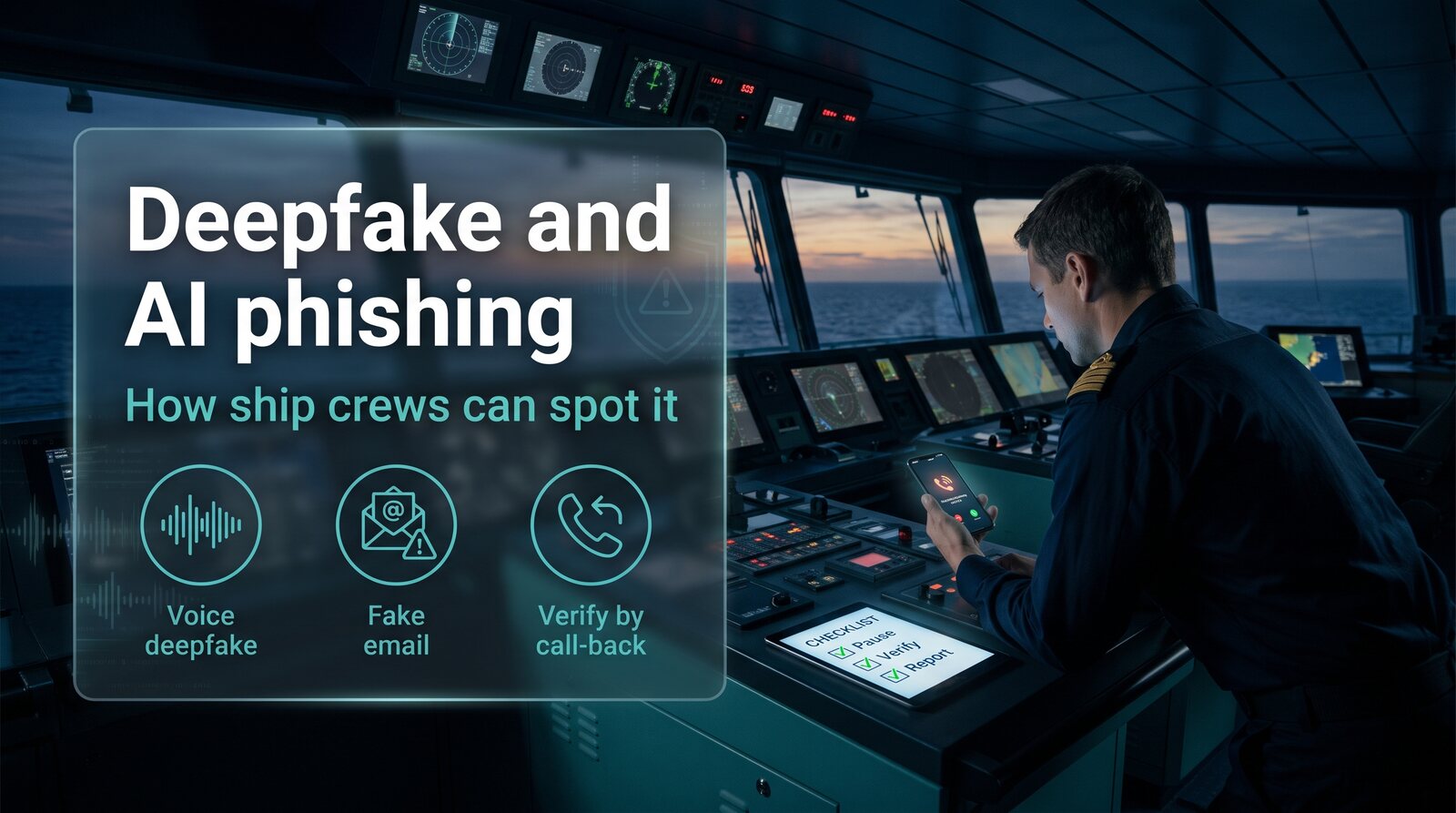
Deepfake and AI Phishing in Shipping: How Crews Can Spot It
Why this is now a maritime cyber problem, not just an office one
Phishing has been the top entry point into company networks for years, but generative AI changes two things: the text is fluent and personalised instead of the broken, generic English that used to be a reliable red flag, and voice and video can now be convincingly faked. In May 2025, this moved from an IT concern to a flagged geopolitical risk: at a UN Security Council debate on 20 May 2025, the malicious use of AI was specifically raised as a critical risk to international shipping, a meaningful signal that this is being treated as an industry-level threat, not an isolated incident.
Shipping is a particularly attractive target for this kind of fraud because so much legitimate business, invoices, change-of-bank-detail notices, urgent requests from a ship's agent or an owner's office, already happens by email across time zones and language barriers. An AI-written message asking for a wire transfer or login details does not need to clear a high bar of suspicion when real business communication already looks almost exactly like that.
What the data says about where attacks actually get in
Industry cyber analysis cited by Crisis24 found that phishing accounted for nearly half, around 48%, of observed maritime cyber incidents in 2024, often serving as the first step before malware is deployed. The same analysis found that crew members are frequently the entry point for an incident, whether through a deliberate click or an honest mistake, and that in 77% of malware cases on vessels, the malware arrived through infected USB sticks or similar removable media rather than through email alone. The pattern is consistent: people, not just firewalls, are the actual target.
What makes AI-generated phishing harder to spot
- Fluent, well-targeted language: a phishing email can now be written in the recipient's own language, with correct grammar and a tone that matches how a real colleague or office writes, instead of the obviously translated text that used to be an easy tell
- Context awareness: attackers can pull real details from a company's website, LinkedIn, or a previous leaked email to make a message reference something true, like a real voyage, a real port call, or a real colleague's name
- Voice cloning: a short public recording, a conference call, a video interview, is enough raw material for current voice-cloning tools to produce a convincing fake of someone's voice
- Video deepfakes: less common on board due to bandwidth, but increasingly used in office-based fraud, where a "video call" with a senior manager is in fact a real-time deepfake
Why this matters specifically for safety management
Phishing and social engineering fall squarely inside the cyber risk that the ISM Code requires companies to manage. Since the 2021 amendments (IMO Resolution MSC.428(98)), cyber risk has had to be addressed within a vessel's safety management system, in the same risk assessment and drill structure as any other operational hazard. BIMCO, together with other industry associations, jointly publishes the Guidelines on Cyber Security Onboard Ships specifically to give companies a shared baseline for this kind of risk, including the human and procedural side, not only technical controls like firewalls and patching.
Practical ways for crews to spot an AI-assisted attempt
- Treat urgency as a warning sign, not a reason to act fast: a message demanding an immediate wire transfer, password reset, or unusual purchase, with pressure not to "bother" a senior officer to confirm, is a classic pattern whether or not AI wrote it
- Verify through a separate, known channel: if an email or call asks for money, credentials, or sensitive data, call back on a phone number you already have on file, not one given in the message itself
- Be suspicious of a request that is slightly out of character, even if the writing style sounds right, because fluent language is no longer proof of a real sender
- Agree a simple verbal or written code word within the company for high-value or unusual requests, such as a wire transfer or a change of bank details, something a cloned voice or a copied writing style cannot guess
- Report anything suspicious through the same channel your SMS already requires for near-misses or incidents, so patterns can be tracked across the fleet instead of being handled, or ignored, vessel by vessel
This is exactly what structured training is for
Spotting an AI-written phishing email or a cloned voice on a call is a trainable skill, not an instinct people are born with, which is why cyber awareness training is increasingly treated as a baseline competence alongside fire drills and enclosed space entry, not an optional extra. Maritime.Studio's maritime cyber awareness training (MCSA) covers this directly for seafarers, shipyard personnel and shore-based office staff, with a shared core and role-specific tracks. See the Maritime Cybersecurity Training programme or download the brochure.
Bottom line
AI has not invented a new category of fraud, phishing and impersonation are old problems, but it has removed the easy tells crews used to rely on: bad grammar, an unfamiliar voice, an obviously fake website. The fix is not a better spam filter alone, it is a crew and shore team that verifies instead of trusts, and a company that treats this as part of its safety management system rather than a side IT issue.