
The IMO's New MASS Code: What "AI-Enabled" Actually Means for Autonomous Ships
A first for IMO: calling a ship "AI-enabled" in a safety instrument
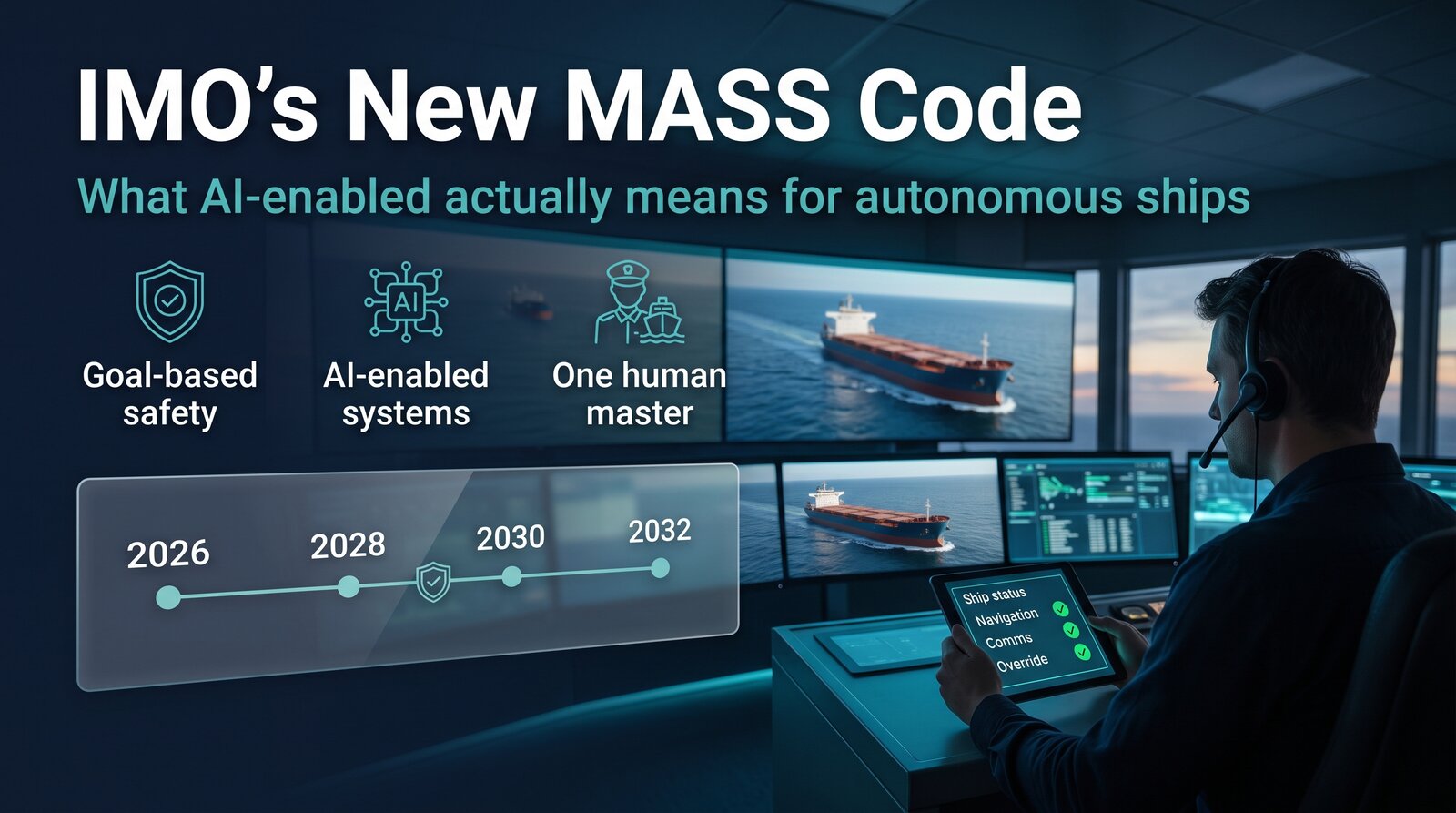
On 22 May 2026, at the close of the 111th session of its Maritime Safety Committee (MSC 111, held 13 to 22 May 2026 in London), the International Maritime Organization announced that it had adopted the International Code of Safety for Maritime Autonomous Surface Ships, known as the MASS Code. IMO's own announcement describes it as a framework "to support the safe integration of AI-enabled and remotely operated commercial ships into global shipping." That phrasing matters: it is the first time IMO has used the term "AI-enabled" in describing a safety code it has adopted, rather than leaving artificial intelligence as an unnamed background technology.
The Code itself, adopted as Resolution MSC.595(111) on 21 May 2026, does not actually use the words "artificial intelligence" anywhere in its technical text. It is written the way IMO writes most of its codes: goal-based, built around definitions, functional requirements and expected performance, with no reference to any specific technology. The "AI-enabled" framing comes from how IMO is presenting the Code to the industry, not from a requirement buried in a chapter. That gap between the announcement and the text is worth understanding before anyone assumes the Code tells you how to certify an AI system.
What the Code actually is, and what it is not
The MASS Code is non-mandatory for now. IMO's resolution invites governments "to take appropriate steps to give effect to the MASS Code" from 1 July 2026, and separately invites them to apply it, as far as practicable, to vessels under 500 gross tonnage. Being non-mandatory means a flag state can choose to apply it, test it and report back, rather than being bound to enforce it the way it would enforce SOLAS. IMO's own framing is explicit that this is deliberate: Member States get a window to try the Code before any move toward making it compulsory.
Chapter 2 of the Code sets its scope precisely: it applies to cargo ships covered by SOLAS chapter I, including any associated Remote Operations Centre, that have systems or functions enabling autonomous or remote operation, where the flag Administration decides that applying other existing IMO instruments is impracticable or insufficient. It explicitly excludes high-speed cargo craft under SOLAS chapter X and warships or other government non-commercial vessels. So this is not a code for every ship with a bit of automation on board. It is a code for ships whose Administration has decided that the normal rulebook does not fit how that particular vessel actually operates.
How the Code defines "autonomous"
Chapter 4 gives the technical definitions that do the real work here. A Maritime Autonomous Surface Ship (MASS) is defined as "a ship which, to a varying degree, can operate independently of human interaction." Separately, "autonomous" is defined as "processes or equipment in a MASS system which are designed and verified to, under specified conditions, determine control action(s) without human intervention." Notice what is missing from both definitions: no reference to machine learning, neural networks or any particular computing method. A rule-based automated system that meets those conditions counts just as much as a system built on a modern AI model. The Code regulates what a system does and how it is verified, not what is inside it.
Where the human stays firmly in charge
The part of the Code most relevant to anyone worried about automation replacing judgment is its treatment of the master. Section 8.7.3 states plainly: "There should be a human master responsible for a MASS, regardless of the mode of operation and the master should have the means to intervene when necessary." A later provision adds that the master "is responsible for the safe operation" of the ship regardless of operating mode, that this master may be located physically on board or remotely, and that "only one master should be responsible for a MASS at any given time." So a remotely operated or autonomous vessel under this Code is not masterless. It has exactly one person, somewhere, who is legally and operationally accountable, with the technical means to override the automation.
This lines up with how IMO Secretary-General Arsenio Dominguez framed the Code at its adoption: "This landmark achievement positions IMO at the forefront of regulating emerging technologies... It represents a major step forward, enabling innovation while ensuring that safety, accountability and the human element remain at the core of maritime operations." The accountability point is not a soft add-on. It is the structural center of the Code.
Certificates, surveys and a Remote Operations Centre of its own
The Code introduces its own certification track rather than bolting autonomy onto existing paperwork. A MASS needs a MASS Safety Certificate following the approval and survey process in Chapters 5 and 6. Where the vessel is controlled from ashore, the Remote Operations Centre itself needs a MASS ROC Certificate, renewed through intermediate, renewal and annual surveys that check the ROC's equipment, its compatibility with the specific vessel it controls, and compliance with the Code. Provisional certificates can be issued so a MASS and its ROC can begin controlled testing before full certification, which matters for an industry that is still mostly at the trial stage rather than running commercial autonomous fleets at scale.
The Code also requires risk assessment (Chapter 7) covering the specific hazards of remote and autonomous operation, and it folds cybersecurity and connectivity into the certification picture rather than treating them as a separate concern bolted on afterward, reflecting how dependent any remote or autonomous system is on the communication link between ship and shore.
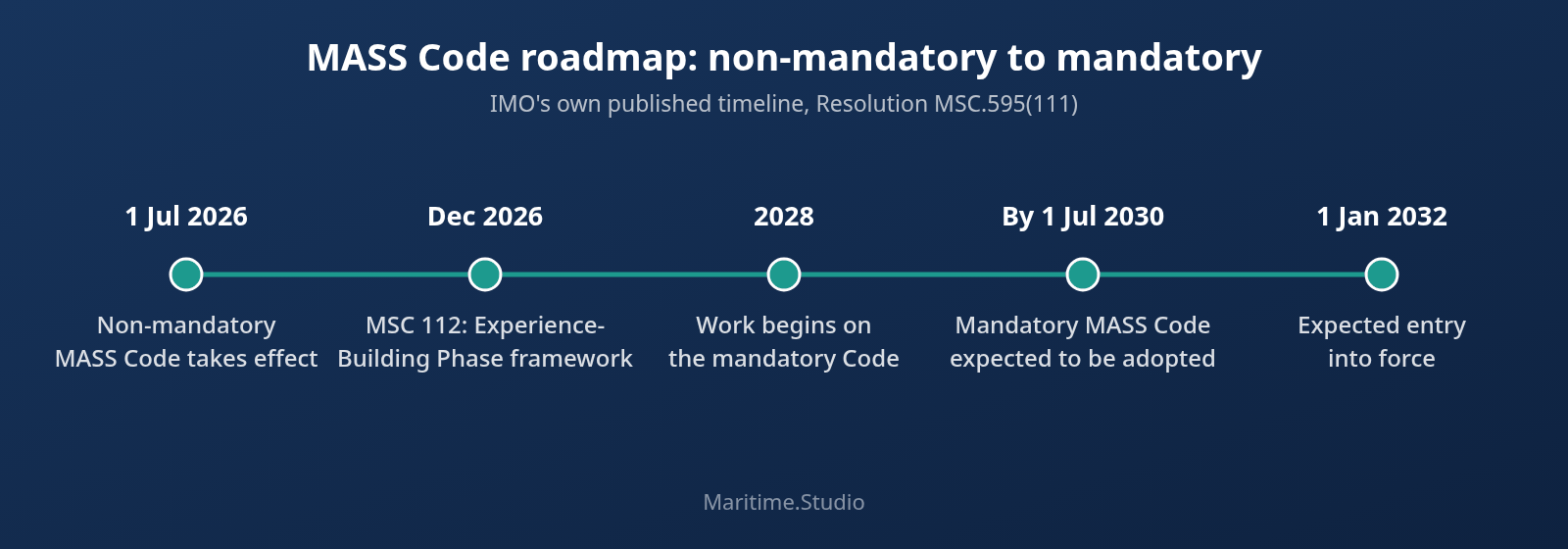
| Date | What happens |
|---|---|
| 1 July 2026 | MASS Code takes effect as a non-mandatory instrument; Administrations can start applying it |
| December 2026 | MSC 112 re-establishes the MASS Working Group to build a framework for an Experience-Building Phase |
| 2028 | Work begins on a mandatory MASS Code, based on the non-mandatory Code and what the Experience-Building Phase and sub-committees find; possible new SOLAS chapter considered |
| By 1 July 2030 | IMO's first mandatory MASS Code is expected to be adopted |
| 1 January 2032 | Expected entry into force of the mandatory MASS Code |
What this means if you are not building an autonomous ship
Most shore offices and crews reading this are not operating a fully autonomous vessel today, and will not be for some years. What changes now is smaller but real. IMO has, for the first time, put an official definition in writing of what counts as a MASS and what "autonomous" means in a safety context, and it has set a public, dated roadmap toward mandatory rules. Companies piloting autonomous surface vessels, remotely controlled harbor craft, or any associated ROC now have a certification path to point to, rather than relying only on class society pilot schemes and flag-specific experimental permits. Anyone training crews or shore staff on AI topics should know the difference between the Code's technology-neutral language and the industry's marketing language, since the two are not the same document.
FAQ
Is the MASS Code mandatory?
No, not yet. It took effect on 1 July 2026 as a non-mandatory instrument. IMO's own roadmap targets adoption of a mandatory version by 1 July 2030, entering into force 1 January 2032, following an Experience-Building Phase and further work by IMO sub-committees.
Does the MASS Code regulate "AI" specifically?
Not in its technical text. The Code defines "autonomous" and "Maritime Autonomous Surface Ship" in technology-neutral terms, based on whether a system is designed and verified to determine control actions without human intervention, regardless of what computing method it uses. IMO's public announcement describes the Code as supporting "AI-enabled" ships, but that is framing, not a legal requirement specific to AI systems.
Does an autonomous ship under this Code operate without a master?
No. The Code requires a human master responsible for the ship at all times, with the means to intervene, whether that master is physically on board or located remotely. Only one master can be responsible for a given MASS at any time.
Talk to us
Maritime.Studio builds digital training for crews and shore teams on emerging maritime technology and regulation, including how AI and autonomy actually fit into IMO's framework. See our autonomous vessels glossary, our maritime cyber awareness training, or get in touch.